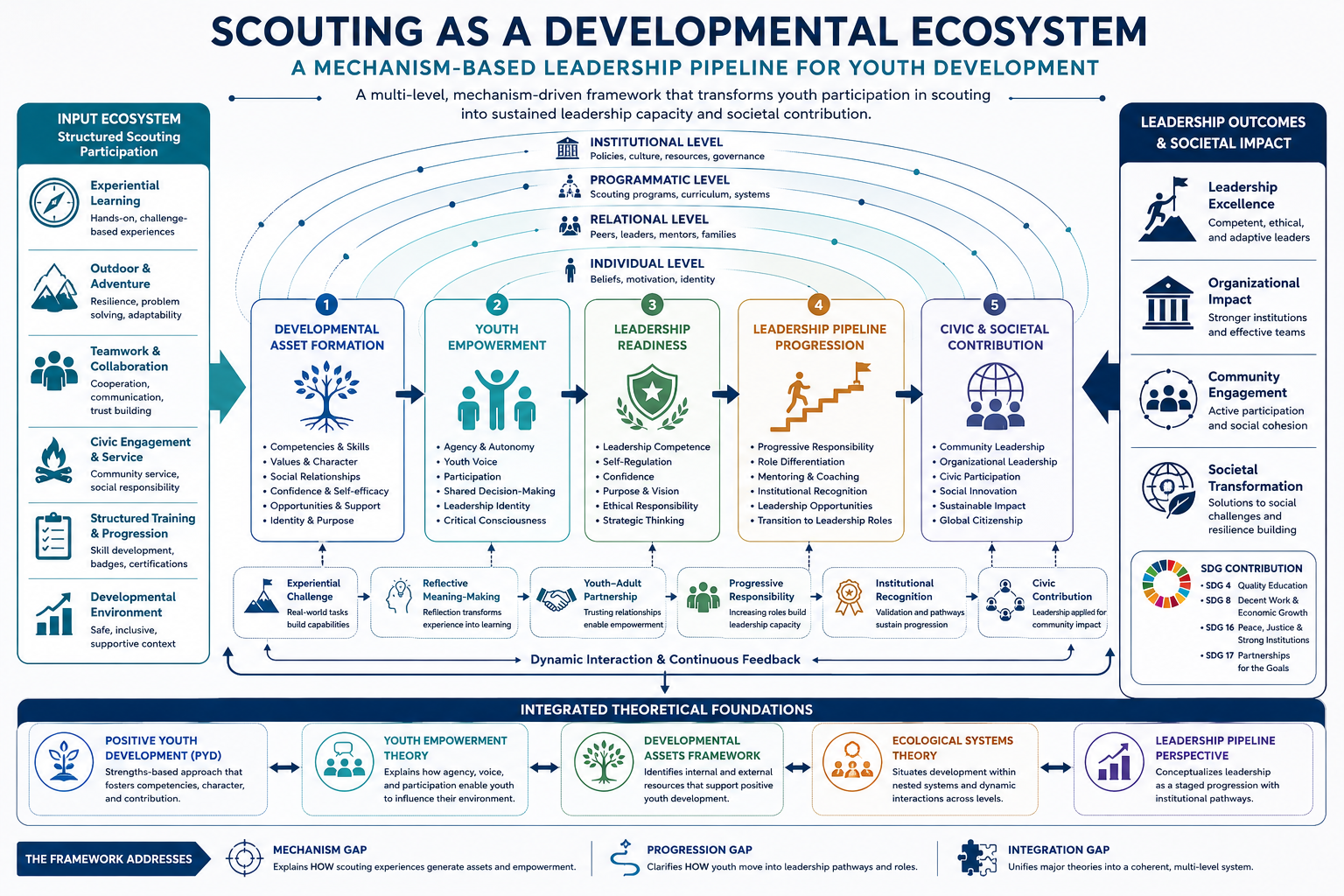
Scouting as a Developmental Ecosystem: A Mechanism-Based Model of Youth Leadership Formation
Keywords:
youth leadership development, positive youth development, youth empowerment, developmental mechanisms, leadership pipeline, nonformal education, scoutingAbstract
Youth leadership development remains a central yet under-theorized domain in contemporary human capital and nonformal education research. While existing studies highlight the outcomes of Positive Youth Development (PYD) and youth empowerment, limited attention has been given to the mechanisms that systematically transform participation into sustained leadership trajectories. Addressing this gap, this article develops a mechanism-based and multi-level conceptual framework that explains how scouting functions as a developmental system shaping youth leadership formation. Drawing on the integration of PYD, youth empowerment theory, developmental assets, ecological systems, and leadership pipeline perspectives, the proposed model conceptualizes leadership as a dynamic and recursive process. It identifies key mechanisms, including experiential challenge, reflective meaning-making, progressive responsibility, and institutional recognition, that collectively drive the progression from training exposure to leadership readiness and pipeline outcomes. The framework contributes theoretically by bridging the mechanism, progression, and integration gaps in youth development literature. Practically, it offers a structured approach for designing youth programs that align developmental processes with leadership pathways. The study provides a foundation for future empirical testing and advances a more comprehensive understanding of youth leadership development in nonformal education contexts.
References
Ardoin, N. M., Bowers, A. W., & Gaillard, E. (2022). Environmental education outcomes for conservation: A systematic review. Biological Conservation, 266, 109464. https://doi.org/10.1016/j.biocon.2021.109464
Ataç, Ö., Özkan, Y., & Karataş, K. (2024). Positive youth development approach: A model specific to Türkiye. Applied Research in Quality of Life, 19, 1557–1581. https://doi.org/10.1007/s11482-023-10270-0
Augsberger, A., Collins, M. E., Gecker, W., & Dougher, M. (2024). Youth empowerment and structural supports: Implications for long-term engagement. Youth & Society, 56(2), 315–334. https://doi.org/10.1177/0044118X221139469
Benson, P. L., & Scales, P. C. (2009). The definition and preliminary measurement of thriving in adolescence. Journal of Positive Psychology, 4(1), 85–104. https://doi.org/10.1080/17439760802399240
Benson, P. L., Scales, P. C., Hamilton, S. F., & Sesma, A. (2006). Positive youth development: Theory, research, and applications. In R. M. Lerner & W. Damon (Eds.), Handbook of child psychology (6th ed.). Wiley. https://doi.org/10.1002/9780470147658.chpsy0116
Bowers, E. P., Geldhof, G. J., Johnson, S. K., Hilliard, L. J., Hershberg, R. M., & Lerner, R. M. (2014). The Five Cs model of positive youth development. Advances in Child Development and Behavior, 46, 165–197. https://doi.org/10.1016/B978-0-12-800285-8.00003-1
Bowers, E. P., Larson, L. R., Sandoval, A. M., & Cloutier, S. (2021). Nature as an ecological asset for positive youth development. Frontiers in Psychology, 12, 688574. https://doi.org/10.3389/fpsyg.2021.688574
Bowers, E. P., Li, Y., Kiely, M. K., Brittian, A., Lerner, J. V., & Lerner, R. M. (2010). The Five Cs model of positive youth development. Journal of Youth and Adolescence, 39(7), 720–735. https://doi.org/10.1007/s10964-010-9530-9
Bronfenbrenner, U., & Morris, P. A. (2006). The bioecological model of human development. In R. M. Lerner (Ed.), Handbook of child psychology (6th ed.). Wiley. https://doi.org/10.1002/9780470147658.chpsy0114
Bronk, K. C. (2014). Purpose in life: A critical component of optimal youth development. Springer. https://doi.org/10.1007/978-94-017-9417-3
Buenconsejo, J. U., & Datu, J. A. D. (2022). Positive youth development: A review. Journal of Psychologists and Counsellors in Schools, 32(2), 275–283. https://doi.org/10.1017/jgc.2021.25
Bunders, A. E., Broerse, J. E. W., Regeer, B. J., & de Winter, M. (2021). Leadership practices in youth organizations. Journal of Leadership Studies. https://doi.org/10.1002/jls.21753
Camiré, M., Trudel, P., & Forneris, T. (2012). Coaching and life skills transfer. Psychology of Sport and Exercise, 13(4), 491–500. https://doi.org/10.1016/j.psychsport.2012.02.002
Cargo, M., & Mercer, S. L. (2008). The value and challenges of participatory research. Annual Review of Public Health, 29, 325–350. https://doi.org/10.1146/annurev.publhealth.29.091307.083824
Catalano, R. F., Berglund, M. L., Ryan, J. A. M., Lonczak, H. S., & Hawkins, J. D. (2004). Positive youth development in the United States. Annals of the American Academy of Political and Social Science, 591, 98–124. https://doi.org/10.1177/0002716203260102
Checkoway, B., & Aldana, A. (2013). Youth participation and community change. Journal of Community Practice, 21(1–2), 1–9. https://doi.org/10.1080/10705422.2013.777871
Chrifou, R., Lenes, R., & Zeijlmans, K. (2024). Youth empowerment in participatory research. International Journal of Adolescence and Youth, 29(1). https://doi.org/10.1080/02673843.2024.2354907
Christens, B. D., & Peterson, N. A. (2012). The role of empowerment in youth development. American Journal of Community Psychology, 50(3–4), 371–385. https://doi.org/10.1007/s10464-011-9480-9
Conner, J. O., & Strobel, K. (2007). Leadership development in adolescence. Journal of Adolescent Research, 22(3), 275–297. https://doi.org/10.1177/0743558407299698
Crowther, S., Hargreaves, J., & Mackintosh, C. (2024). Youth leadership and physical activity. Frontiers in Sports and Active Living, 6, 1490688. https://doi.org/10.3389/fspor.2024.1490688
Damon, W. (2004). What is positive youth development? Annals of the American Academy of Political and Social Science, 591, 13–24. https://doi.org/10.1177/0002716203260092
Damon, W., Menon, J., & Bronk, K. C. (2003). The development of purpose. Applied Developmental Science, 7(3), 119–128. https://doi.org/10.1207/S1532480XADS0703_2
Dimitrova, R., Wiium, N., & Batanova, M. (2018). Developmental assets across cultures. Child & Youth Care Forum, 47, 495–507. https://doi.org/10.1007/s10566-018-9458-2
Durlak, J. A., Weissberg, R. P., & Pachan, M. (2010). A meta-analysis of after-school programs. American Journal of Community Psychology, 45, 294–309. https://doi.org/10.1007/s10464-010-9300-6
Durlak, J. A., Weissberg, R. P., Dymnicki, A. B., Taylor, R. D., & Schellinger, K. B. (2011). Social and emotional learning programs. Child Development, 82(1), 405–432. https://doi.org/10.1111/j.1467-8624.2010.01564.x
Eccles, J. S., & Gootman, J. A. (2002). Community programs to promote youth development. National Academies Press. https://doi.org/10.17226/10022
Flanagan, C. A., & Levine, P. (2010). Civic engagement and youth development. Annual Review of Psychology, 61, 159–179. https://doi.org/10.1146/annurev.psych.093008.100359
Fraser-Thomas, J., Côté, J., & Deakin, J. (2005). Youth sports and development. Psychology of Sport and Exercise, 6(1), 19–40. https://doi.org/10.1016/j.psychsport.2004.02.001
Fredricks, J. A., & Eccles, J. S. (2006). Extracurricular involvement. Developmental Psychology, 42(4), 698–713. https://doi.org/10.1037/0012-1649.42.4.698
Furrer, C. J., Rodgers, A. C., Cooper, C., Rockhill, A., & Lauzus, N. (2023). Youth engagement conditions. Children and Youth Services Review, 155, 107183. https://doi.org/10.1016/j.childyouth.2023.107183
Geldhof, G. J., Bowers, E. P., Mueller, M. K., Napolitano, C. M., Callina, K. S., & Lerner, R. M. (2014). Developmental trajectories of PYD. Journal of Youth and Adolescence, 43, 933–949. https://doi.org/10.1007/s10964-014-0093-z
Gestsdottir, S., & Lerner, R. M. (2008). Positive youth development and self-regulation. Human Development, 51, 202–224. https://doi.org/10.1159/000135757
Gomez-Baya, D., Reis, M., & Gaspar de Matos, M. (2022). Developmental assets and gender. Applied Developmental Science, 26(3), 516–531. https://doi.org/10.1080/10888691.2021.1906676
Gould, D., & Voelker, D. K. (2012). Youth sport leadership development. Journal of Sport Psychology in Action, 3(1), 1–14. https://doi.org/10.1080/21520704.2011.598223
Greeno, E. J., Gould-Kabler, C., Bowman, S., Strubler, K., & Harburger, D. S. (2023). Youth transition planning. Children and Youth Services Review, 149, 106909. https://doi.org/10.1016/j.childyouth.2023.106909
Hamilton, S. F., & Hamilton, M. A. (2009). The youth apprenticeship approach: Preparing young people for careers. Journal of Vocational Behavior, 75(2), 133–141.
https://doi.org/10.1016/j.jvb.2009.04.002
Hansen, D. M., Larson, R. W., & Dworkin, J. B. (2003). What adolescents learn in organized youth activities: A survey of self-reported developmental experiences. Journal of Research on Adolescence, 13(1), 25–55. https://doi.org/10.1111/1532-7795.1301006
Jacquez, F., Vaughn, L. M., & Wagner, E. (2013). Youth as partners, participants or passive recipients: A review of children and adolescents in community-based participatory research (CBPR). American Journal of Community Psychology, 51(1–2), 176–189. https://doi.org/10.1007/s10464-012-9533-7
Jennings, L. B., Parra-Medina, D. M., Hilfinger Messias, D. K., & McLoughlin, K. (2006). Toward a critical social theory of youth empowerment. Journal of Community Practice, 14(1–2), 31–55. https://doi.org/10.1300/J125v14n01_03
Larson, R. W. (2000). Toward a psychology of positive youth development. American Psychologist, 55(1), 170–183. https://doi.org/10.1037/0003-066X.55.1.170
Lerner, R. M. (2004). Liberty: Thriving and civic engagement among America’s youth. Sage Publications.
Lerner, R. M. (2018). Concepts and theories of human development (4th ed.). Routledge. https://doi.org/10.4324/9781315091082
Lerner, R. M., & Callina, K. S. (2014). The study of character development: Towards tests of a relational developmental systems model. Human Development, 57(6), 322–346. https://doi.org/10.1159/000368784
Lerner, R. M., Lerner, J. V., Almerigi, J. B., Theokas, C., Phelps, E., Gestsdottir, S., Naudeau, S., Jelicic, H., Alberts, A. E., Ma, L., Smith, L. M., Bobek, D. L., Richman-Raphael, D., Simpson, I., Christiansen, E. D., & von Eye, A. (2005). Positive youth development, participation in community youth development programs, and community contributions of fifth-grade adolescents: Findings from the first wave of the 4-H study of positive youth development. The Journal of Early Adolescence, 25(1), 17–71. https://doi.org/10.1177/0272431604272461
Mahoney, J. L., Larson, R. W., Eccles, J. S., & Lord, H. (2005). Organized activities as developmental contexts for children and adolescents. In J. L. Mahoney, R. W. Larson, & J. S. Eccles (Eds.), Organized activities as contexts of development: Extracurricular activities, after-school and community programs (pp. 3–22). Lawrence Erlbaum Associates.
Meyers, M. C., van Woerkom, M., & Dries, N. (2020). Talent management: A systematic review and future research agenda. Human Resource Management Review, 30(2), 100708.
https://doi.org/10.1016/j.hrmr.2019.100708
Mitra, D. L. (2008). Student voice in school reform: Building youth–adult partnerships that strengthen schools and empower youth. SUNY Press.
Overton, W. F. (2015). Processes, relations, and relational-developmental-systems. Research in Human Development, 12(3–4), 181–190. https://doi.org/10.1080/15427609.2015.1068030
Ozer, E. J., & Piatt, A. A. (2013). Adolescent participation in research: Innovation, rationale and next steps. American Journal of Community Psychology, 51(3–4), 484–495. https://doi.org/10.1007/s10464-012-9570-2
Peterson, N. A., & Zimmerman, M. A. (2004). Beyond the individual: Toward a nomological network of organizational empowerment. American Journal of Community Psychology, 34(1–2), 129–145. https://doi.org/10.1023/B:AJCP.0000040151.77047.58
Pivec, T., et al. (2023). Youth well-being and resilience in post-pandemic contexts. Journal of Youth Studies, 26(7), 901–918.
https://doi.org/10.1080/13676261.2022.2101015
Roth, J. L., & Brooks-Gunn, J. (2003). What exactly is a youth development program? Answers from research and practice. Applied Developmental Science, 7(2), 94–111. https://doi.org/10.1207/S1532480XADS0702_6
Roth, J. L., Malone, L. M., & Brooks-Gunn, J. (2010). Does the amount of participation in after-school programs relate to developmental outcomes? A review of the literature. American Journal of Community Psychology, 45(3–4), 310–324. https://doi.org/10.1007/s10464-010-9303-3
Scales, P. C., Benson, P. L., Leffert, N., & Blyth, D. A. (2006). Contribution of developmental assets to the prediction of thriving among adolescents. Applied Developmental Science, 10(1), 27–46. https://doi.org/10.1207/s1532480xads1001_3
Syvertsen, A. K., Geldhof, G. J., Ford, K., & Lerner, R. M. (2019). The role of intentional self-regulation, hope, and spirituality in positive youth development. Journal of Youth and Adolescence, 48(9), 1759–1773. https://doi.org/10.1007/s10964-019-01025-8
Trull-Oliva, C., & Soler-Masó, P. (2021). Youth participation and social inclusion: A systematic review. Children and Youth Services Review, 127, 106070.
https://doi.org/10.1016/j.childyouth.2021.106070
Westberg Broström, A. (2013). Scouting as a site for youth development and learning. Journal of Adventure Education and Outdoor Learning, 13(2), 116–130. https://doi.org/10.1080/14729679.2013.769886
Wiium, N., & Dimitrova, R. (2019). Positive youth development across cultures: Introduction to the special issue. Child Indicators Research, 12(4), 1165–1170.
https://doi.org/10.1007/s12187-018-9592-7
Wong, N. T., Zimmerman, M. A., & Parker, E. A. (2010). A typology of youth participation and empowerment for child and adolescent health promotion. American Journal of Community Psychology, 46(1–2), 100–114. https://doi.org/10.1007/s10464-010-9330-0
Zeldin, S., Christens, B. D., & Powers, J. L. (2013).The psychology and practice of youth–adult partnership: Bridging generations for youth development and community change. American Journal of Community Psychology, 51(3–4), 385–397. https://doi.org/10.1007/s10464-012-9558-y