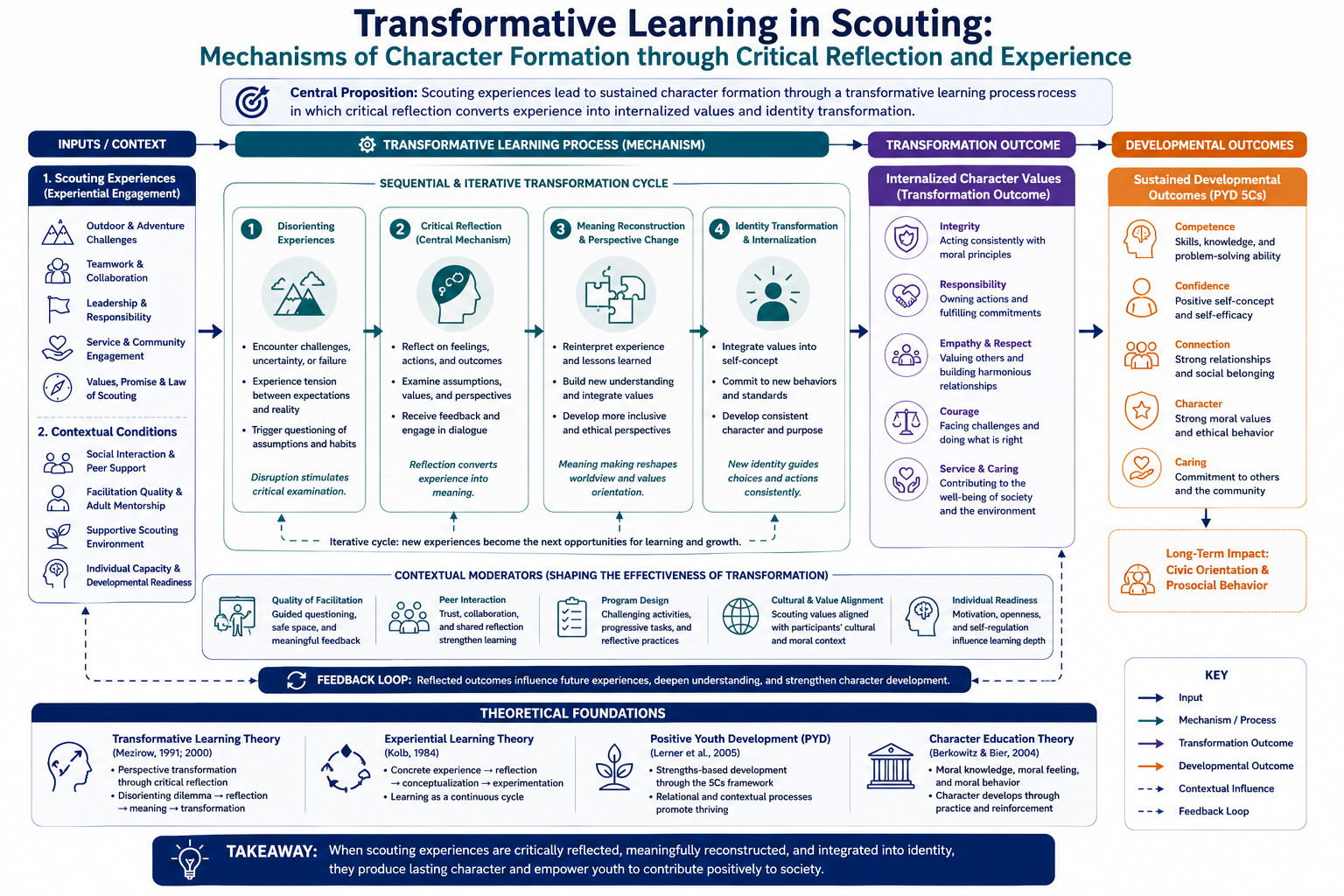
Transformative Learning in Scouting: Mechanisms of Character Formation through Critical Reflection and Experience
Keywords:
mechanism-based model, transformative learning, experiential learning, positive youth development, character formation, youth developmentAbstract
Character formation among youth remains one of the most pressing yet insufficiently explained challenges in contemporary education. Despite extensive research on Positive Youth Development, experiential learning, and transformative learning, existing studies largely emphasize outcomes while overlooking the mechanisms that produce them. This study addresses this limitation by developing a mechanism-based conceptual model that explains how scouting experiences are translated into sustained character development. Drawing on theory synthesis and causal process reasoning, the model conceptualizes transformation as a sequential and iterative process involving disorienting experiences, critical reflection, meaning reconstruction, and identity transformation. Critical reflection is positioned as the central mechanism that converts experiential engagement into internalized character values. The framework further identifies social interaction, facilitation quality, and individual developmental capacity as key contextual conditions shaping the effectiveness of transformation. By shifting the analytical focus from outcomes to mechanisms, this study advances theoretical understanding of youth development and extends transformative learning theory into non-formal education contexts. The proposed model provides a robust foundation for future empirical validation and offers practical insights for designing youth programs that foster deeper and more sustainable character development.
References
Althof, W., & Berkowitz, M. W. (2006). Moral education and character education: Their relationship and roles in citizenship education.Journal of Moral Education, 35(4), 495– 518. https://doi.org/10.1080/03057240601012204
Arbaugh, J. B., & Hwang, A. (2015). Does “teaching presence” exist in online MBA courses? The Internet and Higher Education, 25, 19–27. https://doi.org/10.1016/j.iheduc.2015.01.001
Becker, C., Lauterbach, G., Spengler, S., Dettweiler, U., & Mess, F. (2017). Effects of regular classes in outdoor education settings: A systematic review. International Journal of Environmental Research and Public Health, 14(5), 485. https://doi.org/10.3390/ijerph14050485
Berkowitz, M. W., & Bier, M. C. (2004). Research-based character education. The ANNALS of the American Academy of Political and Social Science, 591(1), 72– 85. https://doi.org/10.1177/0002716203260082
Bowers, E. P., Johnson, S. K., Buckingham, M. H., Gasca, S., Warren, D. J., Lerner, J. V., & Lerner, R. M. (2014). Important non-parental adults and positive youth development. Journal of Youth and Adolescence, 43, 897–918. https://doi.org/10.1007/s10964-014-0096-9
Bronfenbrenner, U., & Morris, P. A. (2006). The bioecological model of human development. In Handbook of Child Psychology. https://doi.org/10.1002/9780470147658.chpsy0114
Brookfield, S. (2017). Becoming a critically reflective teacher. Jossey- Bass. https://doi.org/10.1002/9781119277385
Bundick, M. J. (2011). Extracurricular activities, positive youth development, and meaningful engagement. The Journal of Positive Psychology, 6(1), 57– 74. https://doi.org/10.1080/17439760.2010.536775
Catalano, R. F., Berglund, M. L., Ryan, J. A. M., Lonczak, H. S., & Hawkins, J. D. (2004). Positive youth development in the United States. The ANNALS, 591(1), 98– 124. https://doi.org/10.1177/0002716203260102
Cranton, P . (2006). Understanding and promoting transformative learning. Jossey- Bass. https://doi.org/10.1002/ace.263
Damon, W. (2004). What is positive youth development?The ANNALS, 591(1), 13– 24. https://doi.org/10.1177/0002716203260092
Dirkx, J. M. (2001). The power of feelings in transformative learning. New Directions for Adult and Continuing Education, 2001(89), 63–72. https://doi.org/10.1002/ace.9
Dirkx, J. M. (2012). Nurturing soul in adult learning. New Directions for Adult and Continuing Education, 2012(134), 53–63. https://doi.org/10.1002/ace.20020
Durlak, J. A., Weissberg, R. P., Dymnicki, A. B., Taylor, R. D., & Schellinger, K. B. (2011). Social and emotional learning meta-analysis. Child Development, 82(1), 405– 432. https://doi.org/10.1111/j.1467-8624.2010.01564.x
Fang, B.-B., Lu, F. J. H., Gill, D. L., Liu, S. H., Chyi, T., & Chen, B. (2021). Outdoor education and self-efficacy. Perceptual and Motor Skills, 128(5), 1932– 1958. https://doi.org/10.1177/00315125211022709
Flanagan, C., & Levine, P. (2010). Civic engagement and youth. The Future of Children, 20(1), 159– 179. https://doi.org/10.1353/foc.0.0043
García-Castaño, J., Pulido, M., & Rubio, J. (2020). Scouting and youth development. International Journal of Adolescence and Y outh, 25(1), 775– 789. https://doi.org/10.1080/02673843.2020.1722631
Geldhof, G. J., Bowers, E. P., Boyd, M. J., Mueller, M. K., Napolitano, C. M., Schmid, K. L., Lerner, J. V., & Lerner, R. M. (2014). Creation of short and very short measures of the Five Cs of positive youth development. Journal of Research on Adolescence, 24(1), 163– 176. https://doi.org/10.1111/jora.12039
Gestsdóttir, S., & Lerner, R. M. (2018). Positive development in adolescence: The development and role of intentional self-regulation. Human Development, 61(5–6), 202– 224. https://doi.org/10.1159/000492272
Hattie, J., Marsh, H. W., Neill, J. T., & Richards, G. E. (1997). Adventure education outcomes. Review of Educational Research, 67(1), 43–87. https://doi.org/10.3102/00346543067001043
Hedström, P., & Ylikoski, P. (2010). Causal mechanisms in social sciences. Annual Review of Sociology, 36, 49–67. https://doi.org/10.1146/annurev.soc.012809.102632
Hoggan, C. D. (2016). Transformative learning as a metatheory. Adult Education Quarterly, 66(1), 57– 75. https://doi.org/10.1177/0741713615611216
Illeris, K. (2014). Transformative learning and identity. Journal of Transformative Education, 12(2), 148–163. https://doi.org/10.1177/1541344614548423
Jones, S. M., McGarrah, M. W., & Kahn, J. (2019). Social-emotional learning.Educational Psychologist, 54(3), 129–143. https://doi.org/10.1080/00461520.2019.1625776
Kitchenham, A. (2008). The evolution of John Mezirow’s transformative learning theory. Journal of Transformative Education, 6(2), 104–123. https://doi.org/10.1177/1541344608322678
Kolb, A. Y., & Kolb, D. A. (2009). Experiential learning theory. The SAGE Handbook of Management Learning. https://doi.org/10.4135/9780857021038.n3
Kolb, D. A. (1984). Experiential learning: Experience as the source of learning and development. Prentice-Hall. Kuo, M., Barnes, M., & Jordan, C. (2019). Nature and learning. Frontiers in Psychology, 10, 305. https://doi.org/10.3389/fpsyg.2019.00305
Lerner, R. M., Lerner, J. V., Almerigi, J. B., Theokas, C., Phelps, E., Gestsdóttir, S., Naudeau, S., Jelicic, H., Alberts, A. E., Ma, L., Smith, L. M., Bobek, D. L., Richman-Raphael, D., Simpson, I., Christiansen, E. D., & von Eye, A. (2005). Positive youth development, participation in community youth development programs, and community contributions of fifth-grade adolescents: Findings from the first wave of the 4-H study of positive youth development. The Journal of Early Adolescence, 25(1), 17–71. https://doi.org/10.1177/0272431604272461
Mahoney, J. L., Durlak, J. A., & Weissberg, R. P. (2018). SEL outcomes. Phi Delta Kappan, 100(4), 18–23. https://doi.org/10.1177/0031721718815668
Merriam, S. B. (2004). Transformative learning critique. Adult Education Quarterly, 55(1), 60– 68. https://doi.org/10.1177/0741713604268891
Mezirow, J. (1997). Transformative learning.New Directions for Adult Education, 74, 5– 12. https://doi.org/10.1002/ace.7401
Mezirow, J. (1998). Critical reflection. Adult Education Quarterly, 48(3), 185– 198. https://doi.org/10.1177/074171369804800305
Mezirow, J. (2000). Learning as transformation: Critical perspectives on a theory in progress. Jossey- Bass.
Morris, T . H. (2020). Experiential learning – a systematic review and revision of Kolb’s model. Interactive Learning Environments, 28(8), 1064– 1077. https://doi.org/10.1080/10494820.2019.1570279
Nohl, A.-M. (2015). Phases of transformative learning. Adult Education Quarterly, 65(1), 35– 49. https://doi.org/10.1177/0741713614558582
Rush, A., Brown Urban, J., Davis, W. J., & Linver, M. R. (2024). Scouting and purpose. Journal of Adolescent Research, 39(5), 1326–1357. https://doi.org/10.1177/07435584221091488
Sanderse, W. (2013). Role modelling. Journal of Moral Education, 42(1), 28– 42. https://doi.org/10.1080/03057240.2012.690727
Schön, D. A. (1983). The reflective practitioner: How professionals think in action. Basic Books.
Seaman, J., Brown, M., & Quay, J. (2017). The evolution of experiential learning theory: Tracing lines of research in the JEE. Journal of Experiential Education, 40(4), 1– 16. https://doi.org/10.1177/1053825916689268
Sibthorp, J., Paisley, K., & Furman, N. (2008). Outdoor programs impact. Journal of Experiential Education, 31(3), 262–281. https://doi.org/10.1177/105382590803100304
Spencer, M. B., Swanson, D. P., & Harpalani, V. (2020). The handbook of research on the education of young Black children. Routledge.
Steger, M. F., Oishi, S., & Kashdan, T. B. (2009). Meaning in life. Journal of Positive Psychology, 4(1), 43–52. https://doi.org/10.1080/17439760802303127
Szałachowski, R. R., & Kwiatkowski, P. (2024). Scouting and self-efficacy. Brain Sciences, 14(12), 1268. https://doi.org/10.3390/brainsci14121268
Taylor, E. W. (2007). Transformative learning review. International Journal of Lifelong Education, 26(2), 173–191. https://doi.org/10.1080/02601370701219475
Taylor, E. W., & Cranton, P. (2013). The handbook of transformative learning: Theory, research, and practice. Jossey-Bass.
Taylor, R. D., Oberle, E., Durlak, J. A., & Weissberg, R. P. (2017). SEL and youth development. Child Development, 88(4), 1156–1171. https://doi.org/10.1111/cdev.12864
Ungar, M. (2011). The social ecology of resilience. Springer. https://doi.org/10.1007/978-1-4614- 0586-3
Vygotsky, L. S. (1978). Mind in society. Harvard University Press.
Wagner, L., & Ruch, W. (2023). Character strengths and well-being. The Journal of Positive Psychology, 18(3), 460–480. https://doi.org/10.1080/17439760.2022.2109196
Wenger, E. (1998). Communities of practice: Learning, meaning, and identity. Cambridge University Press.
Youniss, J., Bales, S., Christmas-Best, V., Diversi, M., McLaughlin, M., & Silbereisen, R. (2002). Civic engagement. Journal of Research on Adolescence, 12(1), 121– 148. https://doi.org/10.1111/1532-7795.00027
Zimmerman, B. J. (2000). Self-regulation. Handbook of Self-Regulation. https://doi.org/10.1016/B978- 012109890-2/50031-7