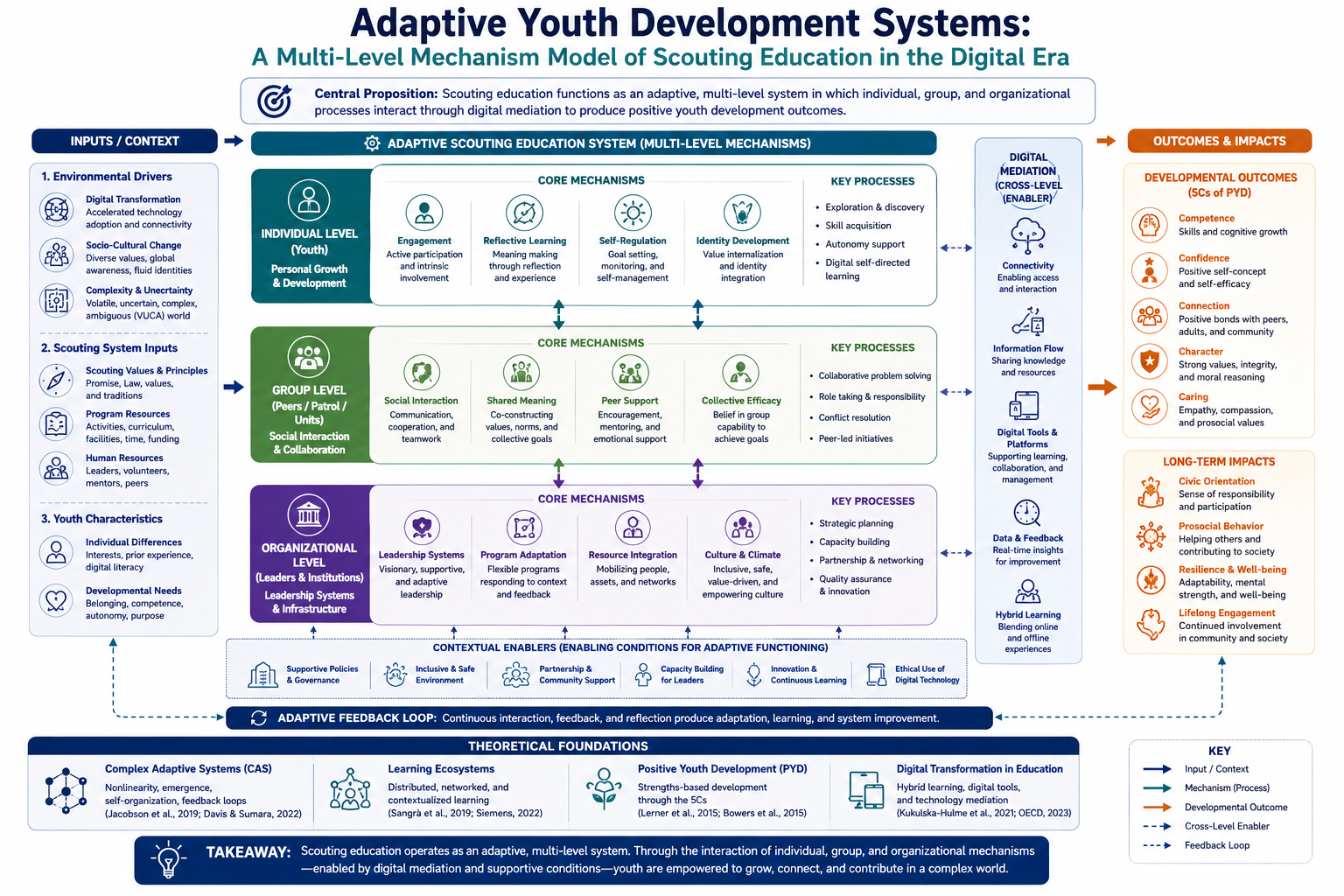
Adaptive Youth Development Systems: A Multi-Level Mechanism Model of Scouting Education in the Digital Era
Keywords:
adaptive youth development, scouting education, learning ecosystems, digital mediation, positive youth development, complex adaptive systemsAbstract
This study develops an integrative conceptual framework that reconceptualizes scouting education as an adaptive youth development system operating across multiple levels in the digital era. The rapid transformation of learning environments driven by digitalization and increasing systemic complexity has created a need for models that go beyond linear and fragmented approaches to youth development. Existing literature on Positive Youth Development, learning ecosystems, and digital transformation remains theoretically disconnected, limiting the ability to explain how developmental processes unfold in contemporary contexts. This study addresses this gap by adopting a theory synthesis approach that integrates complexity theory, learning ecosystem perspectives, and developmental frameworks into a coherent multi-level model. The framework identifies key mechanisms at the individual, group, and organizational levels, including engagement, reflective learning, social interaction, and leadership systems, with digital mediation functioning as a cross level enabler. The proposed model contributes theoretically by offering a mechanism based and multi-level explanation of youth development, and practically by providing guidance for designing adaptive and digitally integrated scouting programs. The framework also establishes a foundation for future empirical research using multi-level and mixed method approaches.
References
Bond, M., Buntins, K., Bedenlier, S., Zawacki-Richter, O., & Kerres, M. (2020). Mapping research in student engagement and educational technology in higher education: A systematic evidence map. International Journal of Educational Technology in Higher Education, 17, Article 2. https://doi.org/10.1186/s41239-019-0176-8
Bond, M., Marín, V. I., Dolch, C., Bedenlier, S., & Zawacki-Richter, O. (2023). Digital transformation in higher education: A systematic review. International Journal of Educational Technology in Higher Education, 20, Article 22. https://doi.org/10.1186/s41239-023-00392-8
Bowers, E. P., Johnson, S. K., Buckingham, M. H., Gasca, S., Warren, D. J., Lerner, J. V., & Lerner, R. M. (2015). Important non-parental adults and positive youth development. Journal of Youth and Adolescence, 44, 118–132. https://doi.org/10.1007/s10964-014-0095-4
Burns, T., & Köster, F. (2021). Governing education in a complex world. OECD Publishing. https://doi.org/10.1787/9789264255364-en
Castañeda, L., & Selwyn, N. (2018). More than tools? Making sense of the ongoing digitizations of higher education. International Journal of Educational Technology in Higher Education, 15, Article 22. https://doi.org/10.1186/s41239-018-0109-y
Crompton, H., & Burke, D. (2023). Artificial intelligence in higher education: The state of the field. International Journal of Educational Technology in Higher Education, 20, Article 22. https://doi.org/10.1186/s41239-023-00392-8
Damon, W. (2004). What is positive youth development? The Annals of the American Academy of Political and Social Science, 591(1), 13–24. https://doi.org/10.1177/0002716203260092
Darling-Hammond, L., Flook, L., Cook-Harvey, C., Barron, B., & Osher, D. (2020). Implications for educational practice of the science of learning and development. Applied Developmental Science, 24(2), 97–140. https://doi.org/10.1080/10888691.2018.1537791
Davis, B., & Sumara, D. (2022). Complexity and education: Inquiries into learning, teaching, and research. Routledge. https://doi.org/10.4324/9780203122808
Day, D. V., Fleenor, J. W., Atwater, L. E., Sturm, R. E., & McKee, R. A. (2014). Advances in leader and leadership development. The Leadership Quarterly, 25(1), 63–82. https://doi.org/10.1016/j.leaqua.2013.11.004
Durlak, J. A., Weissberg, R. P., & Pachan, M. (2010). A meta-analysis of after-school programs. American Journal of Community Psychology, 45, 294–309. https://doi.org/10.1007/s10464-010-9300-6
Eccles, J. S., & Gootman, J. A. (2002). Community programs to promote youth development. National Academy Press. https://doi.org/10.17226/10022
Flanagan, C. A., & Levine, P. (2010). Civic engagement and the transition to adulthood. The Future of Children, 20(1), 159–179. https://doi.org/10.1353/foc.0.0043
Fredricks, J. A., Blumenfeld, P. C., & Paris, A. H. (2004). School engagement. Review of Educational Research, 74(1), 59–109. https://doi.org/10.3102/00346543074001059
Fullan, M. (2021). The new meaning of educational change. Teachers College Press.
Garrison, D. R., Anderson, T., & Archer, W. (2000). Critical inquiry in a text-based environment. The Internet and Higher Education, 2(2–3), 87–105. https://doi.org/10.1016/S1096-7516(00)00016-6
Geldhof, G. J., Bowers, E. P., & Lerner, R. M. (2013). Thriving in context. Journal of Youth and Adolescence, 42, 1–5. https://doi.org/10.1007/s10964-012-9845-7
Hannah, S. T., & Avolio, B. J. (2010). Leader development. Academy of Management Perspectives, 24(1), 118–122. https://doi.org/10.5465/amp.24.1.118
Hrastinski, S. (2008). Asynchronous and synchronous e-learning. Educause Quarterly, 31(4), 51–55.
Jacobson, M. J., Levin, J. A., & Kapur, M. (2019). Education as a complex system. Educational Researcher, 48(2), 112–119. https://doi.org/10.3102/0013189X19826958
Kahu, E. R., & Nelson, K. (2020). Student engagement. Higher Education Research & Development, 39(3), 657–671. https://doi.org/10.1080/07294360.2019.1666254
Kiilakoski, T., & Kivijärvi, A. (2015). Youth clubs as spaces for non-formal learning. Journal of Youth Studies, 18(5), 609–623. https://doi.org/10.1080/13676261.2014.992315
Koh, G. A., & Askell-Williams, H. (2021). Sustainable school improvement. Review of Education, 9(1), 281–314. https://doi.org/10.1002/rev3.3246
Kouzes, J. M., & Posner, B. Z. (2017). The leadership challenge (6th ed.). Wiley. https://doi.org/10.1002/9781119278962
Larson, R. W. (2000). Toward a psychology of positive youth development. American Psychologist, 55(1), 170–183. https://doi.org/10.1037/0003-066X.55.1.170
Larson, R. W., Hansen, D. M., & Moneta, G. (2006). Developmental experiences. Developmental Psychology, 42(5), 849–863. https://doi.org/10.1037/0012-1649.42.5.849
Laurillard, D. (2012). Teaching as a design science. Routledge. https://doi.org/10.4324/9780203125083
Lerner, R. M., Lerner, J. V., Bowers, E. P., & Geldhof, G. J. (2015). Positive youth development. https://doi.org/10.1002/9781118963418.childpsy116
Lerner, R. M., Lerner, J. V., & Benson, J. B. (2011). Positive youth development. https://doi.org/10.1016/B978-0-12-386492-5.00001-0
Lerner, R. M. (2021). Developmental systems theory.
Murphy, S. E., & Johnson, S. K. (2011). Leader development. The Leadership Quarterly, 22(3), 459–470. https://doi.org/10.1016/j.leaqua.2011.04.004
OECD. (2023). Education in the digital age. OECD Publishing.
Ord, J. (2007). Youth work process. Routledge. https://doi.org/10.4324/9780203946060
Overton, W. F. (2015). Relational developmental systems.
Peters, M. J., Guitert, M., & Romero, M. (2022). Learning ecologies. Higher Education Research & Development, 41(7), 2417–2430. https://doi.org/10.1080/07294360.2021.2014408
Postmes, T., Haslam, S. A., & Swaab, R. I. (2020). Social identity theory.
Rogers, A. (2005). Non-formal education. Springer. https://doi.org/10.1007/1-4020-3479-4
Roholt, R. V., Hildreth, R. W., & Baizerman, M. (2014). Youth civic engagement. Routledge. https://doi.org/10.4324/9781315887500
Ryan, R. M., & Deci, E. L. (2020). Self-determination theory. Guilford Press.
Sangrà, A., Raffaghelli, J. E., & Guitert-Catasús, M. (2019). Learning ecologies. British Journal of Educational Technology, 50(4), 1619–1638. https://doi.org/10.1111/bjet.12795
Selwyn, N. (2016). Education and technology. Bloomsbury. https://doi.org/10.5040/9781474235990
Siemens, G. (2022). Learning ecosystems theory.
Skinner, E. A., Kindermann, T. A., & Furrer, C. J. (2009). Engagement. Educational and Psychological Measurement, 69(3), 493–525. https://doi.org/10.1177/0013164408323233
Van Dijk, J. (2020). The digital divide. Polity Press.
Williamson, B., Eynon, R., & Potter, J. (2020). Digital education. Learning, Media and Technology, 45(2), 107–114. https://doi.org/10.1080/17439884.2020.1761641
Zaff, J. F., Boyd, M. J., Li, Y., Lerner, J. V., & Lerner, R. M. (2010). Civic engagement. Developmental Psychology, 46(2), 408–418. https://doi.org/10.1037/a0017391