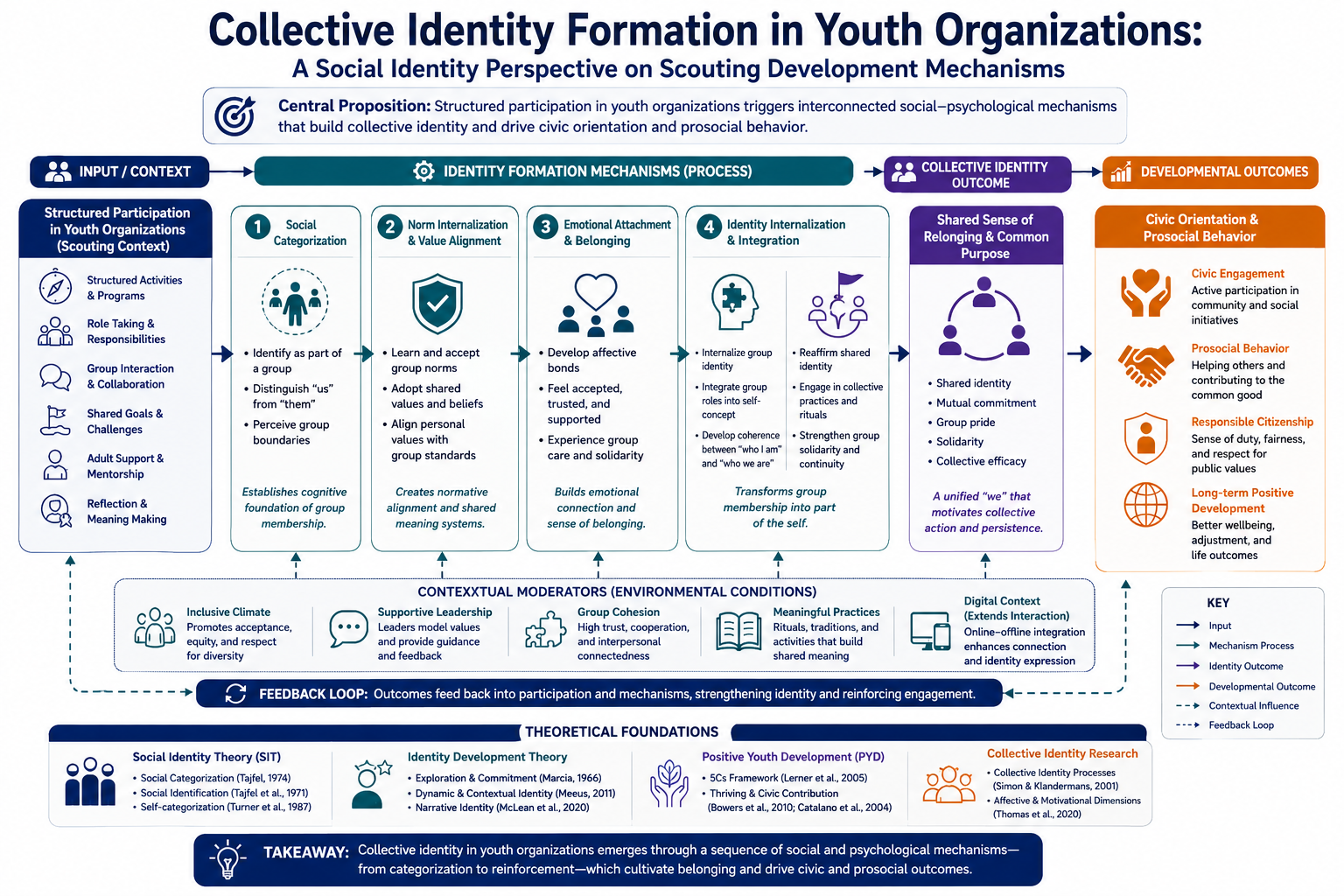
Collective Identity Formation in Youth Organizations: A Social Identity Perspective on Scouting Development Mechanisms
Keywords:
collective identity, identity internalization, mechanism-based theory, social identity theory, structured participation, youth developmentAbstract
The increasing complexity of youth development in contemporary societies requires a deeper understanding of how identity is formed within structured social environments. This article addresses the theoretical fragmentation between social identity theory, identity development, and Positive Youth Development by proposing a mechanism-based conceptual framework that explains how collective identity emerges in youth organizations. The study aims to identify and integrate the key processes linking structured participation, group interaction, and identity internalization into a coherent explanatory model. Using a theory-building approach grounded in integrative synthesis, the framework conceptualizes identity formation as a multi-level and process-oriented phenomenon shaped by social categorization, norm internalization, emotional attachment, and identity reinforcement. The model further explains how these mechanisms collectively produce a shared sense of belonging and ultimately translate into civic orientation and prosocial behavior. The proposed framework contributes theoretically by repositioning identity as a central mechanism rather than an outcome, offering a more precise explanation of how participation leads to developmental and behavioral effects. It also provides a foundation for future empirical research and practical applications in designing identity-driven youth development programs.
References
Aguinis, H., & Glavas, A. (2019). On corporate social responsibility, sensemaking, and the search for meaningfulness through work. Academy of Management Annals, 13(1), 105–154. https://doi.org/10.5465/annals.2017.0075
Allen, K. A., Kern, M. L., Vella-Brodrick, D., Hattie, J., & Waters, L. (2021). What schools need to know about fostering school belonging: A meta-analysis. Educational Psychology Review, 33(2), 543–565. https://doi.org/10.1007/s10648-019-09508-3
Ashforth, B. E., & Mael, F. (1989). Social identity theory and the organization. Academy of Management Review, 14(1), 20–39. https://doi.org/10.5465/amr.1989.4278999
Borsboom, D., Mellenbergh, G. J., & van Heerden, J. (2021). The theoretical status of psychological constructs. Psychological Review, 128(4), 805–832. https://doi.org/10.1037/rev0000257
Bowers, E. P., Li, Y., Kiely, M. K., Brittian, A., Geldhof, G. J., & Lerner, R. M. (2010). The five Cs model of positive youth development. Journal of Youth and Adolescence, 39(7), 720–735. https://doi.org/10.1007/s10964-010-9530-9
Branje, S. (2022). Identity development in adolescence and emerging adulthood. Annual Review of Psychology, 73, 589–616. https://doi.org/10.1146/annurev-psych-020821-114927
Catalano, R. F., Berglund, M. L., Ryan, J. A. M., Lonczak, H. S., & Hawkins, J. D. (2004). Positive youth development in the United States. Annals of the American Academy of Political and Social Science, 591(1), 98–124. https://doi.org/10.1177/0002716203260102
Checkoway, B., & Aldana, A. (2013). Four forms of youth civic engagement. Children and Youth Services Review, 35(11), 1894–1899. https://doi.org/10.1016/j.childyouth.2013.09.005
Crocetti, E. (2017). Identity formation in adolescence. Child Development Perspectives, 11(3), 145–150. https://doi.org/10.1111/cdep.12220
Curran, P. J., Obeidat, K., & Losardo, D. (2010). Twelve frequently asked questions about growth curve modeling. Journal of Cognition and Development, 11(2), 121–136. https://doi.org/10.1080/15248371003699969
Drury, J., & Reicher, S. (2005). Explaining enduring empowerment. European Journal of Social Psychology, 35(1), 35–58. https://doi.org/10.1002/ejsp.233
DuBois, D. L., Portillo, N., Rhodes, J. E., Silverthorn, N., & Valentine, J. C. (2011). How effective are mentoring programs for youth? Psychological Science in the Public Interest, 12(2), 57–91. https://doi.org/10.1177/1529100611414806
Eccles, J. S., & Barber, B. L. (1999). Student council, volunteering, and sports. Journal of Adolescent Research, 14(1), 10–43. https://doi.org/10.1177/0743558499141003
Ellemers, N., Spears, R., & Doosje, B. (2002). Self and social identity. Annual Review of Psychology, 53, 161–186. https://doi.org/10.1146/annurev.psych.53.100901.135228
Flanagan, C. A., & Levine, P. (2010). Civic engagement and the transition to adulthood. The Future of Children, 20(1), 159–179. https://doi.org/10.1353/foc.0.0043
Geldhof, G. J., Bowers, E. P., Boyd, M. J., Mueller, M. K., Napolitano, C. M., Schmid, K. L., Lerner, J. V., & Lerner, R. M. (2013). Creation of short and very short measures of the five Cs of positive youth development. Journal of Youth and Adolescence, 42(11), 1633–1646. https://doi.org/10.1007/s10964-013-9952-9
Geldhof, G. J., Larsen, T., Urke, H., Holsen, I., & Lewis, H. (2023). Positive youth development: Theory and application. In R. M. Lerner (Ed.), Handbook of child psychology and developmental science (Vol. 1). Wiley.
Haslam, S. A., Jetten, J., Cruwys, T., Dingle, G. A., & Haslam, C. (2018). The social identity approach to health. Annual Review of Psychology, 69, 1–26. https://doi.org/10.1146/annurev-psych-122216-011725
Haslam, S. A., Jetten, J., Postmes, T., & Haslam, C. (2009). Social identity, health and well-being. Applied Psychology, 58(1), 1–23. https://doi.org/10.1111/j.1464-0597.2008.00379.x
Haslam, S. A., Reicher, S. D., & Platow, M. J. (2011). The new psychology of leadership: Identity, influence and power. Psychology Press.
Hedström, P., & Ylikoski, P. (2010). Causal mechanisms in the social sciences. Annual Review of Sociology, 36, 49–67. https://doi.org/10.1146/annurev.soc.012809.102632
Hogg, M. A. (2001). A social identity theory of leadership. Personality and Social Psychology Review, 5(3), 184–200. https://doi.org/10.1207/S15327957PSPR0503_1
Hogg, M. A., & Reid, S. A. (2006). Social identity, self-categorization, and communication. Communication Theory, 16(1), 7–30. https://doi.org/10.1111/j.1468-2885.2006.00003.x
Hornsey, M. J. (2008). Social identity theory and self-categorization theory. Personality and Social Psychology Review, 12(2), 204–224. https://doi.org/10.1177/1088868308316890
Kende, A., van Zomeren, M., Ujhelyi, A., & Lantos, N. A. (2021). The social identity model of collective action. Current Opinion in Psychology, 35, 58–63. https://doi.org/10.1016/j.copsyc.2020.03.003
Kozlowski, S. W. J., Chao, G. T., Grand, J. A., Braun, M. T., & Kuljanin, G. (2013). Advancing multilevel research design: Capturing the dynamics of emergence. Organizational Research Methods, 16(4), 581–615. https://doi.org/10.1177/1094428113493119
Kroger, J. (2017). Identity development: Adolescence through adulthood (3rd ed.). SAGE Publications.
Lawford, H. L., & Ramey, H. L. (2017). Predictors of civic engagement among youth: The roles of extracurricular involvement and identity. Journal of Youth and Adolescence, 46(5), 1031–1045. https://doi.org/10.1007/s10964-016-0592-3
Lerner, R. M., Almerigi, J. B., Theokas, C., & Lerner, J. V. (2005). Positive youth development: A view of the issues. Journal of Early Adolescence, 25(1), 10–16. https://doi.org/10.1177/0272431604273211
Lerner, R. M., Johnson, S. K., & Buckingham, M. H. (2018). Relational developmental systems theory. Handbook of Life Course Health Development, 23–38. https://doi.org/10.1007/978-3-319-47143-3_2
Lerner, R. M., Lerner, J. V., Bowers, E. P., & Geldhof, G. J. (2015). Positive youth development and relational-developmental-systems. In W. F. Overton & P. C. M. Molenaar (Eds.), Handbook of child psychology and developmental science (7th ed., Vol. 1, pp. 607–651). Wiley.
Luyckx, K., Goossens, L., Soenens, B., & Beyers, W. (2006). Unpacking commitment and exploration: Preliminary validation of an integrative model of adolescent identity formation. Journal of Adolescence, 29(3), 361–378. https://doi.org/10.1016/j.adolescence.2005.03.008
Luyckx, K., Schwartz, S. J., Goossens, L., Soenens, B., & Beyers, W. (2008). Developmental typologies of identity formation. Journal of Personality and Social Psychology, 95(3), 776–794. https://doi.org/10.1037/0022-3514.95.3.776
McLean, K. C., Syed, M., Yoder, A., & Greenhoot, A. F. (2020). The empirical structure of narrative identity: The initial Big Three. Developmental Psychology, 56(5), 920–934. https://doi.org/10.1037/dev0000905
Meeus, W. (2011). The study of adolescent identity formation 2000–2010: A review of longitudinal research. Journal of Research on Adolescence, 21(1), 75–94. https://doi.org/10.1111/j.1532-7795.2010.00716.x
Nesi, J., Choukas-Bradley, S., & Prinstein, M. J. (2022). Social media and adolescent development. Annual Review of Psychology, 73, 357–378. https://doi.org/10.1146/annurev-psych-020821-114927
Odgers, C. L., & Jensen, M. R. (2020). Adolescent mental health in the digital age. Journal of Child Psychology and Psychiatry, 61(3), 336–348. https://doi.org/10.1111/jcpp.13190
Portes, A. (1998). Social capital: Its origins and applications. Annual Review of Sociology, 24, 1–24. https://doi.org/10.1146/annurev.soc.24.1.1
Putnam, R. D. (2000). Bowling alone: The collapse and revival of American community. Simon & Schuster.
Reicher, S. D., Haslam, S. A., & Hopkins, N. (2005). Social identity and the dynamics of leadership. The Leadership Quarterly, 16(4), 547–568. https://doi.org/10.1016/j.leaqua.2005.06.007
Rhodes, J. E., & DuBois, D. L. (2008). Mentoring relationships and youth development. Journal of Community Psychology, 36(2), 254–267. https://doi.org/10.1002/jcop.20241
Roth, J. L., & Brooks-Gunn, J. (2003). What exactly is a youth development program? Answers from research and practice. Applied Developmental Science, 7(2), 94–111. https://doi.org/10.1207/S1532480XADS0702_6
Schwartz, S. J., Zamboanga, B. L., Weisskirch, R. S., & Rodriguez, L. (2011). The relationships of personal and cultural identity. Journal of Personality, 79(4), 823–859. https://doi.org/10.1111/j.1467-6494.2010.00681.x
Simon, B., & Klandermans, B. (2001). Politicized collective identity. American Psychologist, 56(4), 319–331. https://doi.org/10.1037/0003-066X.56.4.319
Stets, J. E., & Burke, P. J. (2000). Identity theory and social identity theory. Social Psychology Quarterly, 63(3), 224–237. https://doi.org/10.2307/2695870
Syed, M., Juang, L. P., & Svensson, Y. (2024). Toward a contextualized and dynamic understanding of identity. Developmental Review, 72, 101119. https://doi.org/10.1016/j.dr.2024.101119
Tajfel, H. (1974). Social identity and intergroup behaviour. Social Science Information, 13(2), 65–93. https://doi.org/10.1177/053901847401300204
Tajfel, H., Billig, M. G., Bundy, R. P., & Flament, C. (1971). Social categorization and intergroup behaviour. European Journal of Social Psychology, 1(2), 149–178. https://doi.org/10.1002/ejsp.2420010202
Terry, D. J., & Hogg, M. A. (1996). Group norms and the attitude–behavior relationship. Journal of Personality and Social Psychology, 70(4), 776–793. https://doi.org/10.1037/0022-3514.70.4.776
Umaña-Taylor, A. J., Quintana, S. M., Lee, R. M., Cross, W. E., Jr., Rivas-Drake, D., Schwartz, S. J., Syed, M., Yip, T., & Seaton, E. (2014). Ethnic and racial identity during adolescence and into young adulthood. Child Development, 85(1), 21–39. https://doi.org/10.1111/cdev.12196
van Zomeren, M., Postmes, T., & Spears, R. (2008). Toward an integrative model of collective action. Psychological Bulletin, 134(4), 504–535. https://doi.org/10.1037/0033-2909.134.4.504
Vignoles, V. L., Schwartz, S. J., & Luyckx, K. (2021). Toward an integrative view of identity. Annual Review of Psychology, 72, 499–526. https://doi.org/10.1146/annurev-psych-050419-103413
Walton, G. M., & Brady, S. T. (2020). The many questions of belonging. Annual Review of Psychology, 71, 363–388. https://doi.org/10.1146/annurev-psych-010419-050914
Wang, M.-T., Fredricks, J. A., Ye, F., Hofkens, T. L., & Linn, J. S. (2023). The math and science engagement scales. Developmental Psychology, 59(2), 234–248. https://doi.org/10.1037/dev0001470
Youniss, J., McLellan, J. A., & Yates, M. (2002). Religion, community service, and identity in American youth. Journal of Adolescence, 25(2), 243–253. https://doi.org/10.1006/jado.2002.0470