Scouting as an Experiential Learning Ecosystem: Reconfiguring Youth Development Mechanisms in Nonformal Education
Keywords:
experiential learning ecosystem, positive youth development, nonformal education, learning ecosystems, youth development mechanisms, scouting educationAbstract
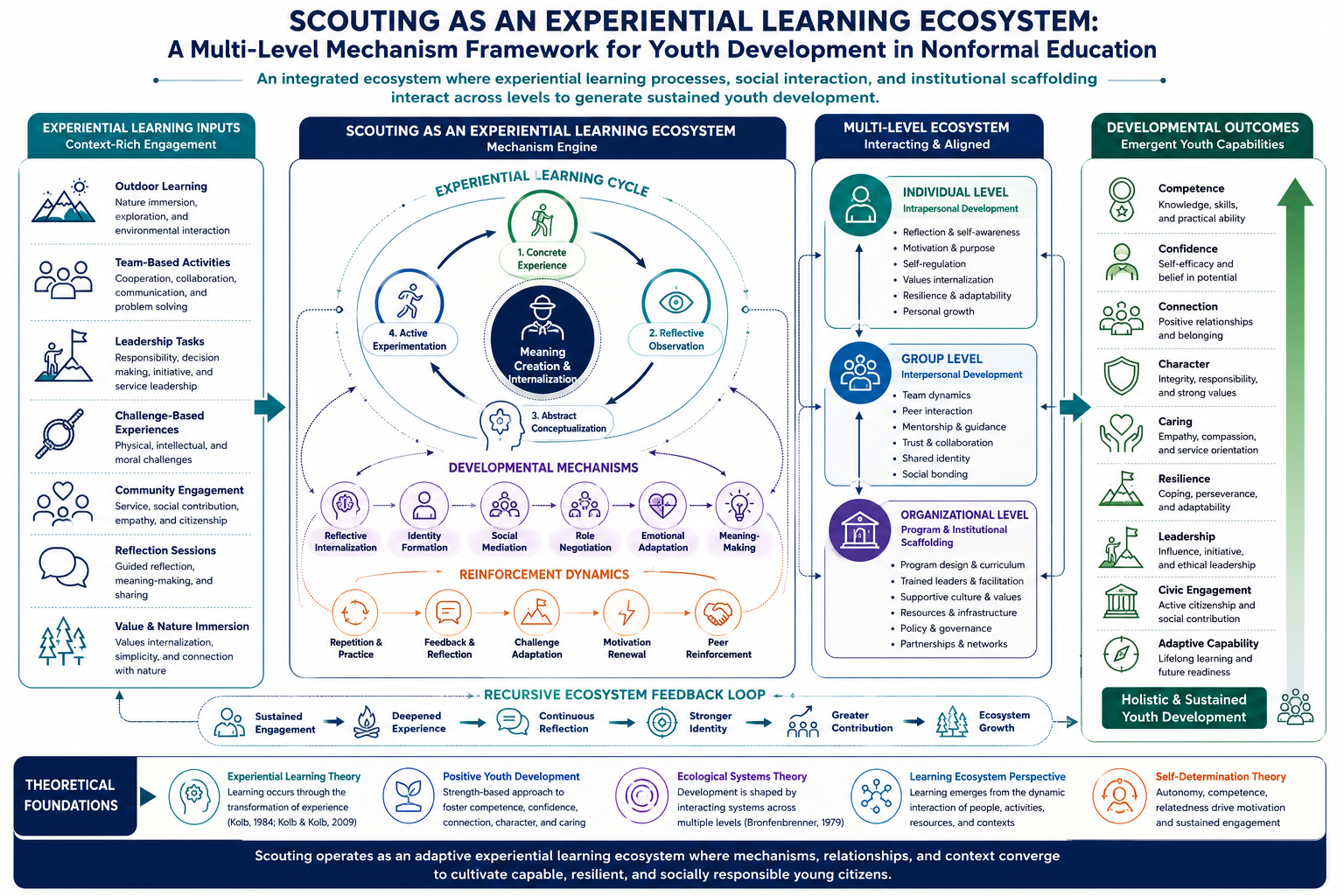
The contemporary landscape of youth development is increasingly characterized by disengagement, declining civic participation, and a growing mismatch between formal education systems and the competencies required in complex, real-world contexts. While experiential learning, positive youth development, and learning ecosystem perspectives offer valuable insights, these theoretical streams remain fragmented, limiting their ability to explain how structured youth programs generate developmental outcomes. This article aims to address this gap by proposing a unified conceptual framework that positions scouting as an experiential learning ecosystem. Using a theory synthesis approach, the study integrates experiential learning processes, developmental outcomes, and multi-level contextual dynamics into a mechanism-based model. The framework explicates how key mechanisms such as reflective internalization, identity formation, social interaction, and institutional scaffolding interact across individual, group, and organizational levels to produce sustained youth development. Theoretically, the model advances a multi-level and process-oriented understanding of learning in nonformal education contexts. It also provides a foundation for empirical testing and offers implications for designing more effective youth development programs in increasingly complex and hybrid learning environments.
References
Barron, B. (2006). Interest and self-sustained learning as catalysts of development: A learning ecology perspective. Human Development, 49(4), 193–224. https://doi.org/10.1159/000094368
Beard, C., & Wilson, J. P. (2013). Experiential learning: A handbook for education, training and coaching (2nd ed.). Kogan Page.
Becker, C., Lauterbach, G., Spengler, S., Dettweiler, U., & Mess, F. (2017). Effects of regular classes in outdoor education settings: A systematic review on students’ learning, social and health dimensions. International Journal of Environmental Research and Public Health, 14(5), 485. https://doi.org/10.3390/ijerph14050485
Benson, P. L., Scales, P. C., Hamilton, S. F., & Sesma, A. (2006). Positive youth development: Theory, research, and applications. In W. Damon & R. M. Lerner (Eds.), Handbook of child psychology (6th ed., pp. 894–941). Wiley.
Billett, S. (2016). Apprenticeship and applied learning. Springer.
Boud, D., Keogh, R., & Walker, D. (1993). Reflection: Turning experience into learning. Routledge.
Bowers, E. P., Geldhof, G. J., Johnson, S. K., Hilliard, L. J., Hershberg, R. M., Lerner, J. V., & Lerner, R. M. (2021). Promoting positive youth development: Lessons from the 4-H study. Journal of Youth Development, 16(3), 1–20. https://doi.org/10.5195/jyd.2021.1033
Bronfenbrenner, U. (1979). The ecology of human development. Harvard University Press.
Bronfenbrenner, U., & Morris, P. A. (2006). The bioecological model of human development. In W. Damon & R. M. Lerner (Eds.), Handbook of child psychology (pp. 793–828). Wiley.
Cantor, P., Osher, D., Berg, J., Steyer, L., & Rose, T. (2021). Malleability, plasticity, and individuality: How children learn and develop in context. Applied Developmental Science, 25(1), 1–15. https://doi.org/10.1080/10888691.2020.1787163
Catalano, R. F., Berglund, M. L., Ryan, J. A., Lonczak, H. S., & Hawkins, J. D. (2004). Positive youth development in the United States: Research findings. Annals of the American Academy of Political and Social Science, 591(1), 98–124. https://doi.org/10.1177/0002716203260102
Catalano, R. F., Skinner, M. L., Alvarado, G., Kapungu, C., Reavley, N., Patton, G. C., … Petroni, S. (2019). Positive youth development programs in low- and middle-income countries. Journal of Adolescent Health, 65(1), S15–S31. https://doi.org/10.1016/j.jadohealth.2019.03.024
Chan, C. K. Y., Fong, E. T. Y., Luk, L. Y. Y., & Ho, R. (2021). A review of experiential learning in higher education. Journal of Applied Research in Higher Education, 13(4), 1012–1027. https://doi.org/10.1108/JARHE-03-2020-0073
Ciocanel, O., Power, K., Eriksen, A., & Gillings, K. (2017). Effectiveness of positive youth development interventions. Journal of Youth and Adolescence, 46(3), 483–504. https://doi.org/10.1007/s10964-016-0555-6
Coombs, P. H., & Ahmed, M. (1974). Attacking rural poverty: How nonformal education can help. Johns Hopkins University Press.
Damon, W. (2004). What is positive youth development? Annals of the American Academy of Political and Social Science, 591(1), 13–24. https://doi.org/10.1177/0002716203260092
Darling-Hammond, L., Flook, L., Cook-Harvey, C., Barron, B., & Osher, D. (2020). Implications for educational practice of the science of learning. Applied Developmental Science, 24(2), 97–140. https://doi.org/10.1080/10888691.2018.1537791
Duerden, M. D., Widmer, M. A., Taniguchi, S. T., & McCoy, J. K. (2012). The impact of outdoor adventure education. Journal of Outdoor Recreation, Education, and Leadership, 4(4), 231–245.
Eccles, J., & Gootman, J. A. (2002). Community programs to promote youth development. National Academies Press.
Fenwick, T. (2001). Experiential learning: A theoretical critique. Routledge.
Garst, B. A., Browne, L. P., & Bialeschki, M. D. (2011). Youth development and the camp experience. New Directions for Youth Development, 2011(130), 73–87. https://doi.org/10.1002/yd.398
Geldhof, G. J., Bowers, E. P., Boyd, M. J., Mueller, M. K., Napolitano, C. M., Schmid, K. L., & Lerner, R. M. (2014). Creation of short and very short measures of the Five Cs of positive youth development. Journal of Research on Adolescence, 24(1), 163–176. https://doi.org/10.1111/jora.12039
Goldenberg, M., McAvoy, L., & Klenosky, D. B. (2005). Outcomes from the components of an outdoor education program. Journal of Experiential Education, 28(2), 123–146.
Hahn, T., Minola, T., & Eddleston, K. (2022). Experiential learning in entrepreneurship education. Academy of Management Learning & Education, 21(1), 1–20. https://doi.org/10.5465/amle.2020.0024
Hattie, J., Marsh, H. W., Neill, J. T., & Richards, G. E. (1997). Adventure education and outward bound. Review of Educational Research, 67(1), 43–87. https://doi.org/10.3102/00346543067001043
Hirsh-Pasek, K., Zosh, J. M., Golinkoff, R. M., Gray, J. H., Robb, M. B., & Kaufman, J. (2015). Putting education in educational apps. Psychological Science in the Public Interest, 16(1), 3–34. https://doi.org/10.1177/1529100615569721
Illeris, K. (2007). How we learn: Learning and non-learning in school and beyond. Routledge.
Immordino-Yang, M. H., Darling-Hammond, L., & Krone, C. (2019). The brain basis for integrated social, emotional, and academic development. Educational Researcher, 48(3), 127–142. https://doi.org/10.3102/0013189X19842679
Jackson, N. (2013). Lifewide learning, education and personal development. CreateSpace.
Kolb, D. A. (1984). Experiential learning. Prentice Hall.
Kolb, A. Y., & Kolb, D. A. (2005). Learning styles and learning spaces. Academy of Management Learning & Education, 4(2), 193–212. https://doi.org/10.5465/amle.2005.17268566
Kolb, A. Y., & Kolb, D. A. (2009). Experiential learning theory. Academy of Management Learning & Education, 8(2), 297–306. https://doi.org/10.5465/amle.2009.41788836
Kolb, A. Y., & Kolb, D. A. (2017). The experiential educator. Experience Based Learning Systems.
Kuo, M., Barnes, M., & Jordan, C. (2019). Do experiences with nature promote learning? Frontiers in Psychology, 10, 305. https://doi.org/10.3389/fpsyg.2019.00305
Lerner, R. M. (2017). Positive youth development. Journal of Youth Development, 12(2), 1–8.
Lerner, R. M., Almerigi, J. B., Theokas, C., & Lerner, J. V. (2005). Positive youth development. Journal of Early Adolescence, 25(1), 10–16. https://doi.org/10.1177/0272431604273211
Lerner, R. M., & Callina, K. S. (2014). The study of character development. Journal of Youth Development, 9(2), 5–21.
Manolis, C., Burns, D. J., Assudani, R., & Chinta, R. (2013). Assessing experiential learning styles. Journal of Marketing Education, 35(1), 44–55. https://doi.org/10.1177/0273475312465092
Marsick, V. J., & Watkins, K. E. (2015). Informal and incidental learning. New Directions for Adult and Continuing Education, 2015(89), 25–34.
Morris, T. H. (2020). Experiential learning: A systematic review. Educational Research Review, 30, 100325. https://doi.org/10.1016/j.edurev.2020.100325
Mygind, E., Stevenson, M. P., Liebst, L. S., Konvalinka, I., Bentsen, P., & Hjortso, C. N. (2019). Stress response to nature-based education. Health & Place, 58, 102136. https://doi.org/10.1016/j.healthplace.2019.102136
National Academies of Sciences, Engineering, and Medicine. (2018). How people learn II. National Academies Press. https://doi.org/10.17226/24783
Noe, R. A., Clarke, A. D. M., & Klein, H. J. (2014). Learning in the twenty-first-century workplace. Annual Review of Organizational Psychology, 1, 245–275. https://doi.org/10.1146/annurev-orgpsych-031413-091321
OECD. (2020). OECD learning compass 2030. OECD Publishing.
Osher, D., Cantor, P., Berg, J., Steyer, L., & Rose, T. (2020). Drivers of human development. Applied Developmental Science, 24(1), 6–36. https://doi.org/10.1080/10888691.2017.1398650
Paisley, K., Furman, N., Sibthorp, J., & Gookin, J. (2008). Student learning in outdoor education. Journal of Experiential Education, 30(3), 201–213.
Passarelli, A. M., & Kolb, D. A. (2012). Using experiential learning theory. Simulation & Gaming, 43(1), 69–79. https://doi.org/10.1177/1046878111420357
Pellegrino, J. W., & Hilton, M. L. (2012). Education for life and work. National Academies Press.
Priest, S., & Gass, M. A. (2017). Effective leadership in adventure programming (3rd ed.). Human Kinetics.
Roberts, J. W. (2012). Beyond learning by doing. Routledge.
Rogers, A. (2004). Non-formal education. Springer.
Roth, J. L., & Brooks-Gunn, J. (2003). What exactly is a youth development program? Applied Developmental Science, 7(2), 94–111. https://doi.org/10.1207/S1532480XADS0702_6
Ryan, R. M., & Deci, E. L. (2020). Intrinsic and extrinsic motivation. Contemporary Educational Psychology, 61, 101860. https://doi.org/10.1016/j.cedpsych.2020.101860
Sawyer, R. K. (2014). The Cambridge handbook of the learning sciences (2nd ed.). Cambridge University Press.
Schunk, D. H., & DiBenedetto, M. K. (2020). Motivation and social cognitive theory. Contemporary Educational Psychology, 60, 101832. https://doi.org/10.1016/j.cedpsych.2019.101832
Siemens, G. (2005). Connectivism: A learning theory for the digital age. International Journal of Instructional Technology and Distance Learning, 2(1), 3–10.
Sibthorp, J., Paisley, K., & Gookin, J. (2007). Exploring participant development through adventure-based programming. Journal of Experiential Education, 30(2), 111–126.
Stern, M. J., Powell, R. B., & Ardoin, N. M. (2014). What difference does it make? Journal of Environmental Education, 45(3), 183–198. https://doi.org/10.1080/00958964.2014.901251
Taylor, R. D., Oberle, E., Durlak, J. A., & Weissberg, R. P. (2017). Promoting positive youth development. Child Development, 88(4), 1156–1171. https://doi.org/10.1111/cdev.12864
Thurber, C. A., Scanlin, M. M., Scheuler, L., & Henderson, K. A. (2007). Youth development outcomes of the camp experience. Journal of Experiential Education, 30(3), 252–275.
Tillmann, S., Tobin, D., Avison, W., & Gilliland, J. (2018). Mental health benefits of interactions with nature. Journal of Environmental Psychology, 58, 1–8. https://doi.org/10.1016/j.jenvp.2018.07.004
Yardley, S., Teunissen, P. W., & Dornan, T. (2012). Experiential learning. Medical Teacher, 34(2), e102–e115. https://doi.org/10.3109/0142159X.2012.643264