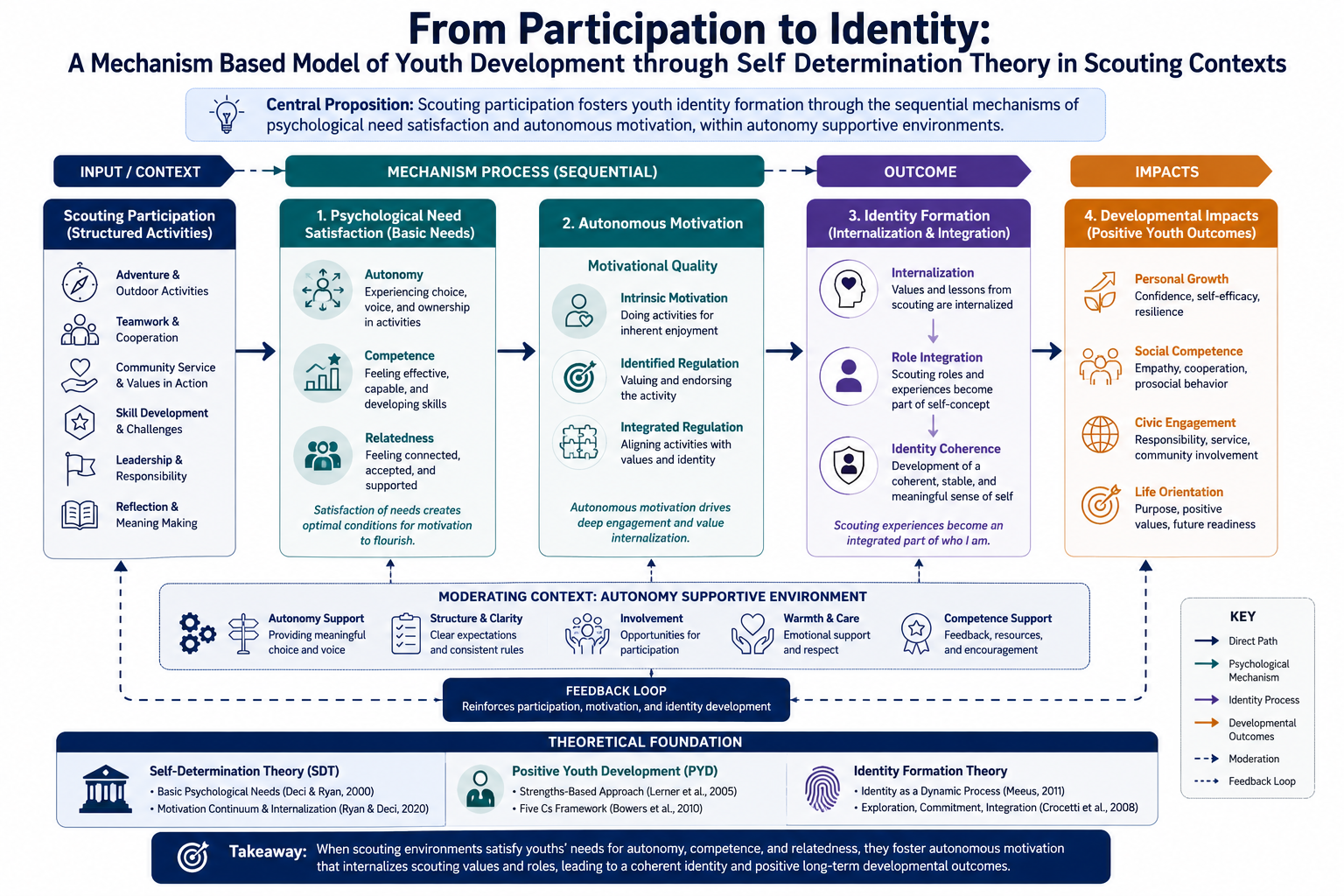
From Participation to Identity: A Mechanism Based Model of Youth Development through Self Determination Theory in Scouting Contexts
Keywords:
autonomous motivation, identity formation, positive youth development, psychological need satisfaction, self-determination theory, youth developmentAbstract
This article develops a mechanism-based conceptual model explaining how participation in scouting activities contributes to youth identity formation through motivational processes. Drawing on Self-Determination Theory, Positive Youth Development, and identity formation literature, the study argues that participation in scouting does not directly produce developmental outcomes, but operates through sequential psychological mechanisms. Specifically, structured scouting participation is theorized to foster psychological need satisfaction, including autonomy, competence, and relatedness. These fulfilled needs subsequently promote autonomous motivation, which facilitates internalization and supports the integration of scouting experiences, values, and roles into a coherent sense of self. The proposed model positions psychological need satisfaction and autonomous motivation as central mediating mechanisms, while autonomy supportive environments function as contextual moderators that strengthen developmental pathways. By integrating fragmented literatures on youth development, motivation, and identity, this article advances a process-oriented explanation of how non-formal educational contexts contribute to long-term developmental outcomes. The framework offers theoretical contributions by extending Self-Determination Theory into scouting contexts and practical implications for designing youth programs that support autonomy, competence, relatedness, reflection, and identity development. Future research should empirically test the proposed model using longitudinal and structural equation modeling approaches across diverse cultural settings.
References
Aelterman, N., Vansteenkiste, M., Haerens, L., Soenens, B., Fontaine, J. R. J., & Reeve, J. (2019). Toward an integrative and fine-grained insight in motivating and demotivating teaching styles. Journal of Educational Psychology, 111(3), 497–521. https://doi.org/10.1037/edu0000293
Benson, P. L., Scales, P. C., Hamilton, S. F., & Sesma, A. (2006). Positive youth development: Theory, research, and applications. Handbook of Child Psychology. https://doi.org/10.1002/9780470147658.chpsy0116
Berkovich, I., & Gueta, B. (2022). The effect of autonomy-supportive climate in a second chance programme for at-risk youth on dropout risk. European Journal of Psychology of Education, 37, 85–100. https://doi.org/10.1007/s10212-021-00542-4
Bowen, D. J., & Neill, J. T. (2013). A meta-analysis of adventure therapy outcomes. Clinical Psychology Review, 33(1), 28–53. https://doi.org/10.1016/j.cpr.2012.09.005
Bowers, E. P., Li, Y., Kiely, M. K., Brittian, A., Lerner, J. V., & Lerner, R. M. (2010). The Five Cs model of positive youth development. Journal of Youth and Adolescence, 39, 720–735. https://doi.org/10.1007/s10964-010-9530-9
Bureau, J. S., Howard, J. L., Chong, J. X. Y., & Guay, F. (2022). Pathways to student motivation. Review of Educational Research, 92(1), 46–72. https://doi.org/10.3102/00346543211042426
Catalano, R. F., Berglund, M. L., Ryan, J. A. M., Lonczak, H. S., & Hawkins, J. D. (2004). Positive youth development in the United States. The ANNALS of the American Academy of Political and Social Science, 591(1), 98–124. https://doi.org/10.1177/0002716203260102
Ciocanel, O., Power, K., Eriksen, A., & Gillings, K. (2017). Effectiveness of positive youth development interventions. Journal of Youth and Adolescence, 46, 483–504. https://doi.org/10.1007/s10964-016-0555-6
Crocetti, E., Rubini, M., & Meeus, W. (2008). Capturing the dynamics of identity formation. Journal of Adolescence, 31(2), 207–222. https://doi.org/10.1016/j.adolescence.2007.09.004
Cronin, L., Ellison, P., Allen, J., Huntley, E., Johnson, L., Kosteli, M. C., Hollis, A., & Marchant, D. (2022). A self-determination theory based investigation of life skills development in youth sport. Journal of Sports Sciences, 40(8), 886–898. https://doi.org/10.1080/02640414.2022.2028507
Damon, W. (2004). What is positive youth development? The ANNALS of the American Academy of Political and Social Science, 591(1), 13–24. https://doi.org/10.1177/0002716203260092
Deci, E. L., Koestner, R., & Ryan, R. M. (1999). A meta-analytic review of experiments examining extrinsic rewards and intrinsic motivation. Psychological Bulletin, 125(6), 627–668. https://doi.org/10.1037/0033-2909.125.6.627
Deci, E. L., & Ryan, R. M. (2000). The what and why of goal pursuits. Psychological Inquiry, 11(4), 227–268. https://doi.org/10.1207/S15327965PLI1104_01
Deci, E. L., Ryan, R. M., & Williams, G. C. (1996). Need satisfaction and self-regulation of learning. Learning and Individual Differences, 8(3), 165–183. https://doi.org/10.1016/S1041-6080(96)90013-8
Dibben, C., Playford, C., & Mitchell, R. (2017). Be prepared: Scouting, mental health and later life. Journal of Epidemiology and Community Health, 71(3), 275–281. https://doi.org/10.1136/jech-2016-207898
Durlak, J. A., Weissberg, R. P., & Pachan, M. (2010). After-school programs that promote personal and social skills. American Journal of Community Psychology, 45, 294–309. https://doi.org/10.1007/s10464-010-9300-6
Eccles, J. S., & Barber, B. L. (1999). Student council, volunteering, basketball, or marching band. Journal of Adolescent Research, 14(1), 10–43. https://doi.org/10.1177/0743558499141003
Eccles, J. S., Barber, B. L., Stone, M., & Hunt, J. (2003). Extracurricular activities and adolescent development. Journal of Social Issues, 59(4), 865–889. https://doi.org/10.1046/j.0022-4537.2003.00095.x
Feldman, A. F., & Matjasko, J. L. (2005). The role of school-based extracurricular activities. Review of Educational Research, 75(2), 159–210. https://doi.org/10.3102/00346543075002159
Fredricks, J. A., & Eccles, J. S. (2006). Is extracurricular participation associated with beneficial outcomes? Developmental Psychology, 42(4), 698–713. https://doi.org/10.1037/0012-1649.42.4.698
Fredricks, J. A., & Simpkins, S. D. (2013). Organized out-of-school activities and peer relationships. New Directions for Child and Adolescent Development, 2013(140), 57–73. https://doi.org/10.1002/cad.20043
Grolnick, W. S., & Ryan, R. M. (1987). Autonomy in children’s learning. Journal of Educational Psychology, 79(4), 508–517. https://doi.org/10.1037/0022-0663.79.4.508
Guay, F. (2022). Applying self-determination theory to education. Canadian Journal of School Psychology, 37(1), 75–92. https://doi.org/10.1177/08295735211055355
Hansen, D. M., Larson, R. W., & Dworkin, J. B. (2003). What adolescents learn in organized youth activities. Journal of Research on Adolescence, 13(1), 25–55. https://doi.org/10.1111/1532-7795.1301006
Hardy, S. A., Dollahite, D. C., Johnson, N., & Christensen, J. B. (2015). Adolescent motivations to engage in prosocial behaviors. Journal of Personality, 83(5), 479–490. https://doi.org/10.1111/jopy.12123
Hattie, J., Marsh, H. W., Neill, J. T., & Richards, G. E. (1997). Adventure education and outward bound. Review of Educational Research, 67(1), 43–87. https://doi.org/10.3102/00346543067001043
Howard, J. L., Bureau, J. S., Guay, F., Chong, J. X. Y., & Ryan, R. M. (2021). Student motivation and associated outcomes. Psychological Bulletin, 147(8), 822–854. https://doi.org/10.1037/bul0000339
Jang, H., Kim, E. J., & Reeve, J. (2016). Why students become more engaged or disengaged. Learning and Instruction, 43, 27–38. https://doi.org/10.1016/j.learninstruc.2016.01.002
Jang, H., Reeve, J., & Deci, E. L. (2010). Engaging students in learning activities. Learning and Instruction, 20(6), 588–600. https://doi.org/10.1016/j.learninstruc.2009.08.002
Laporte, N., Soenens, B., Brenning, K., & Vansteenkiste, M. (2021). Adolescents as active managers of their own psychological needs. Journal of Adolescence, 88, 67–83. https://doi.org/10.1016/j.adolescence.2021.02.004
Larson, R. W. (2000). Toward a psychology of positive youth development. American Psychologist, 55(1), 170–183. https://doi.org/10.1037/0003-066X.55.1.170
Larson, R. W., Hansen, D. M., & Moneta, G. (2006). Differing profiles of developmental experiences. Developmental Psychology, 42(5), 849–863. https://doi.org/10.1037/0012-1649.42.5.849
Lerner, R. M., Almerigi, J. B., Theokas, C., & Lerner, J. V. (2005). Positive youth development. The Journal of Early Adolescence, 25(1), 10–16. https://doi.org/10.1177/0272431604273211
Lerner, R. M., Lerner, J. V., Bowers, E. P., & Geldhof, G. J. (2015). Positive youth development and relational-developmental-systems. Handbook of Child Psychology and Developmental Science, 1–45. https://doi.org/10.1002/9781118963418.childpsy116
Martela, F., & Ryan, R. M. (2016). The benefits of benevolence. Journal of Happiness Studies, 17, 1043–1062. https://doi.org/10.1007/s10902-015-9638-2
Martela, F., Hankonen, N., Ryan, R. M., & Vansteenkiste, M. (2021). Motivating voluntary compliance to behavioural restrictions. European Review of Social Psychology, 32(2), 305–347. https://doi.org/10.1080/10463283.2020.1857082
Meeus, W. (2011). The study of adolescent identity formation. Journal of Adolescence, 34(1), 75–94. https://doi.org/10.1016/j.adolescence.2010.11.002
Ntoumanis, N., Ng, J. Y. Y., Prestwich, A., Quested, E., Hancox, J. E., Thøgersen-Ntoumani, C., Deci, E. L., Ryan, R. M., Lonsdale, C., & Duda, J. L. (2021). A meta-analysis of self-determination theory-informed intervention studies. Health Psychology Review, 15(2), 214–244. https://doi.org/10.1080/17437199.2020.1718529
Niemiec, C. P., & Ryan, R. M. (2009). Autonomy, competence, and relatedness in the classroom. Theory and Research in Education, 7(2), 133–144. https://doi.org/10.1177/1477878509104318
Reeve, J. (2009). Why teachers adopt a controlling motivating style. Educational Psychologist, 44(3), 159–175. https://doi.org/10.1080/00461520903028990
Reeve, J., & Cheon, S. H. (2021). Autonomy-supportive teaching. Educational Psychology Review, 33, 669–701. https://doi.org/10.1007/s10648-020-09566-0
Ryan, R. M., & Connell, J. P. (1989). Perceived locus of causality and internalization. Journal of Personality and Social Psychology, 57(5), 749–761. https://doi.org/10.1037/0022-3514.57.5.749
Ryan, R. M., & Deci, E. L. (2020). Intrinsic and extrinsic motivation from a self-determination theory perspective. Contemporary Educational Psychology, 61, 101860. https://doi.org/10.1016/j.cedpsych.2020.101860
Sheldon, K. M., Ryan, R. M., Deci, E. L., & Kasser, T. (2004). The independent effects of goal contents and motives. Personality and Social Psychology Bulletin, 30(4), 475–486. https://doi.org/10.1177/0146167203261883
Soenens, B., & Vansteenkiste, M. (2005). Antecedents and outcomes of self-determination. Journal of Youth and Adolescence, 34, 589–604. https://doi.org/10.1007/s10964-005-8948-y
Szałachowski, R. R., Tuszyńska-Bogucka, W., & Dąbska, O. (2024). Scouting as a strategy in support of mental health. Brain Sciences, 14(12), 1268. https://doi.org/10.3390/brainsci14121268